


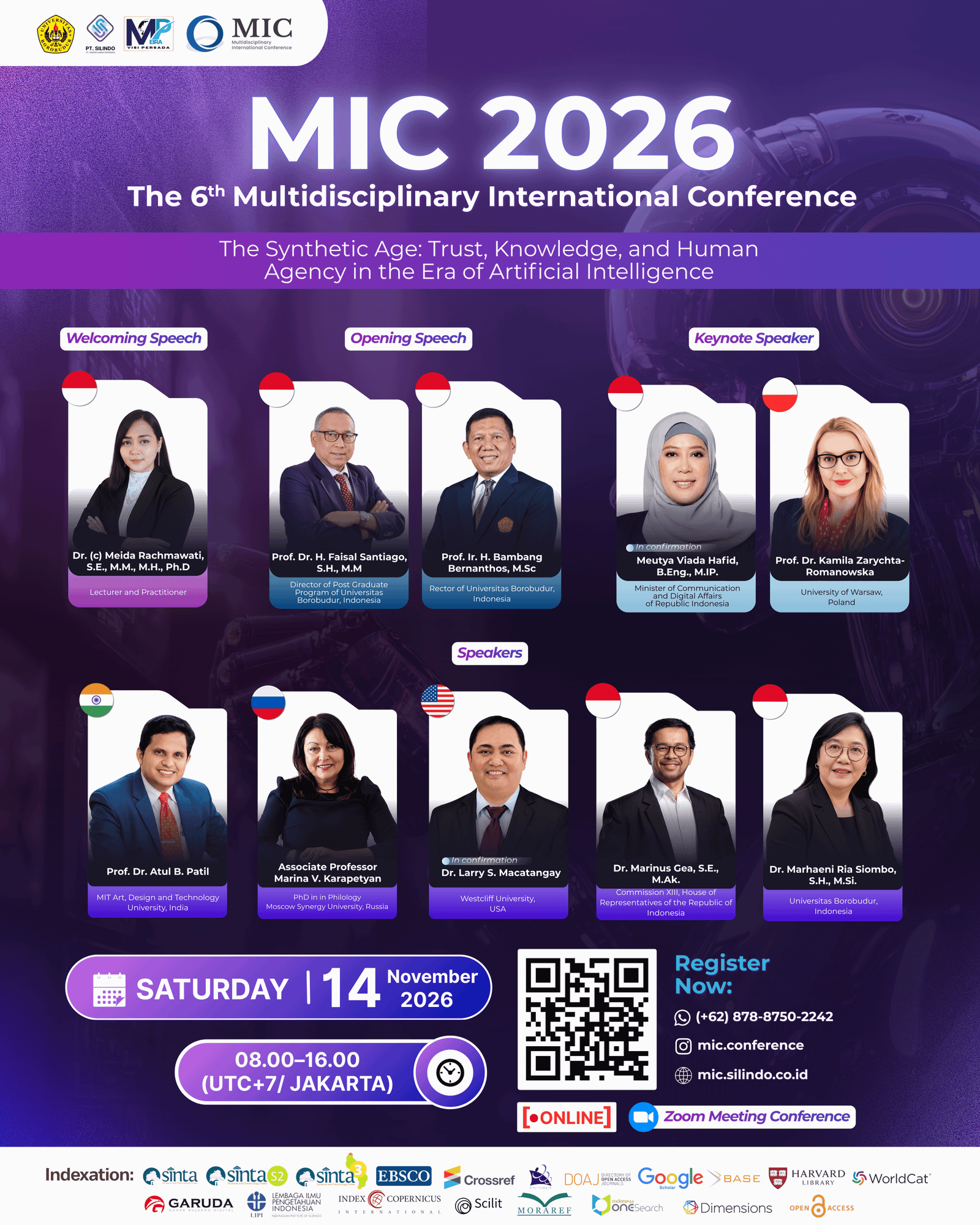
Speakers, schedule, and registration details at a glance. Click the poster to view it full size.
As artificial intelligence increasingly shapes what we know, what we see, how we work, and how we make decisions, how can society preserve trust, protect knowledge, and strengthen human agency?
The 6th Multidisciplinary International Conference (MIC 2026) explores the profound transformation brought about by Artificial Intelligence and Generative AI as they increasingly shape how society creates knowledge, accesses information, communicates, works, learns, and makes decisions.
Framed by the theme “The Synthetic Age: Trust, Knowledge, and Human Agency in the Era of Artificial Intelligence,” MIC 2026 examines how the growing capacity to generate and manipulate digital content is reshaping technological systems, social relations, institutions, economies, education, governance, law, and human behavior.
Trust in an increasingly synthetic information environment.
Knowledge in a landscape where AI participates in its production.
Preserving autonomy, judgment, accountability and meaningful control.
MIC has continuously evolved in response to major transformations in technology, society, governance, and human development.
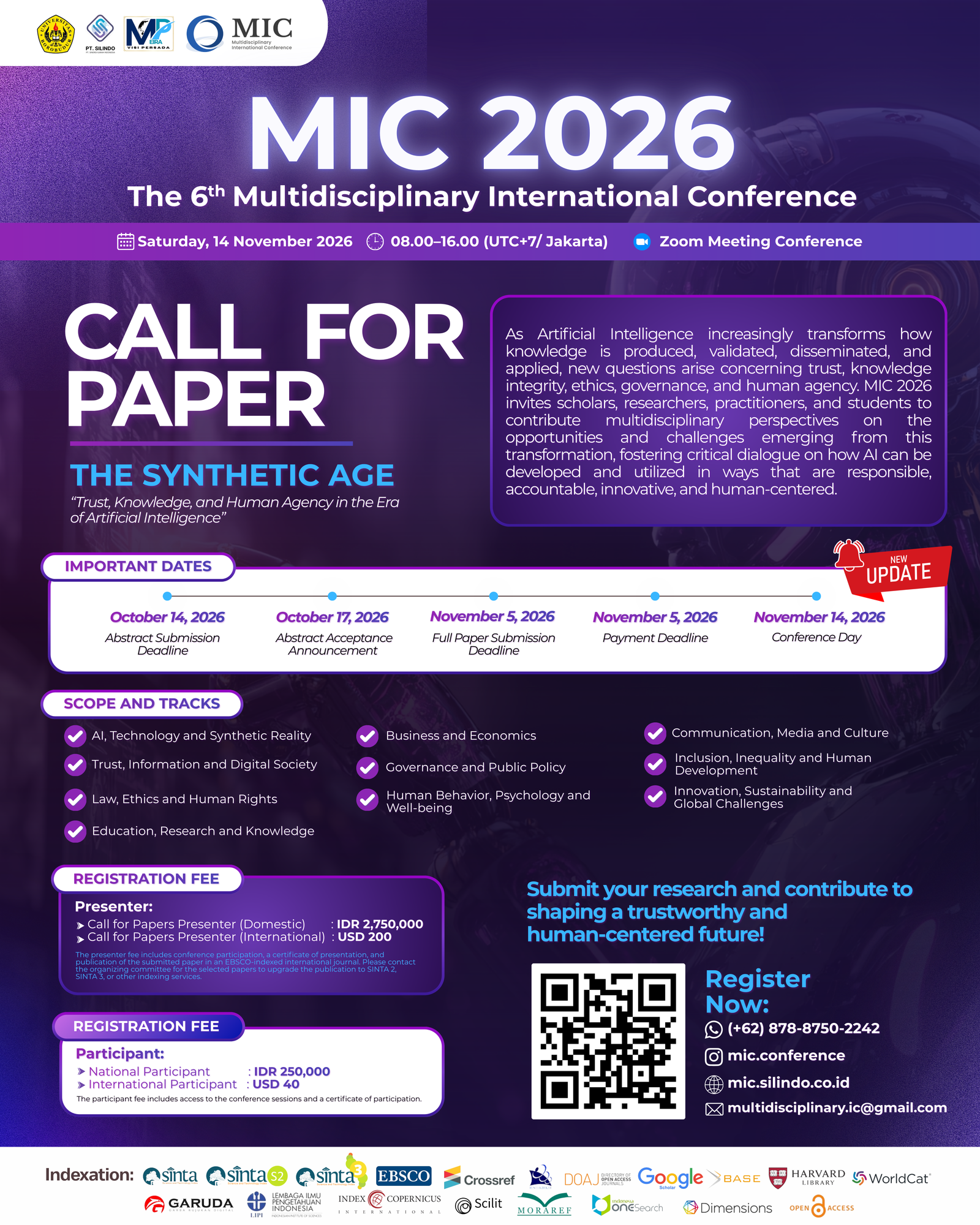
As Artificial Intelligence increasingly transforms how knowledge is produced, validated, disseminated, and applied, new questions arise concerning trust, knowledge integrity, ethics, governance, and human agency.
MIC 2026 invites scholars, researchers, practitioners, and students to contribute multidisciplinary perspectives on the opportunities and challenges emerging from this transformation.
14 October 2026
Letter of Acceptance
5 November 2026
5 November 2026
08:00–16:00 WIB • Zoom
Contributions are welcomed from diverse theoretical, empirical, methodological, and applied perspectives.
Generative AI, LLMs, AI agents, synthetic media, deepfakes, digital identity, cybersecurity, automation, human–AI interaction and synthetic environments.
Misinformation, disinformation, media trust, information disorder, digital literacy, algorithmic influence and polarization.
AI regulation, privacy, data protection, intellectual property, algorithmic accountability, digital rights, AI ethics and human rights.
AI in education, AI literacy, academic integrity, research ethics, digital learning, knowledge production and academic transformation.
AI adoption, digital economy, productivity, innovation, consumer behavior, entrepreneurship, future of work and economic transformation.
AI governance, public administration, institutional trust, policy innovation, transparency, accountability and digital government.
Human agency, decision-making, psychology of AI, behavioral change, digital behavior, cognitive processes and digital well-being.
Synthetic media, journalism, digital communication, cultural transformation, content creation, media literacy and public communication.
Digital divide, AI divide, inclusive innovation, accessibility, marginalized communities, digital inclusion and human development.
AI-driven innovation, sustainable development, climate change, resilient societies, responsible innovation and technology for sustainable futures.
MIC 2026 recognizes that the challenges of The Synthetic Age cannot be adequately addressed through a single discipline.
The conference encourages research that crosses disciplinary boundaries and connects technology with law, knowledge with governance, innovation with sustainability, and AI with human development.
The presenter fee includes conference participation, certificate of presentation, and publication of the submitted paper in an EBSCO-indexed international journal.
The presenter fee includes conference participation, a certificate of presentation, and publication of the submitted paper in an EBSCO-indexed international journal. Please contact the organizing committee for the selected papers to upgrade the publication to SINTA 2, SINTA 3, or other indexing services.
The participant fee includes access to conference sessions and a certificate of participation.
| Benefit | Presenter | Participant |
|---|---|---|
| Submit a scientific article | ✓ | × |
| Participate in article review process | ✓ | × |
| Present in Parallel Session | ✓ | × |
| Participant E-Certificate | ✓ | ✓ |
| Presenter E-Certificate | ✓ | × |
| Letter of Acceptance | ✓ | × |
| Opportunity for article publication | ✓ | × |
| Access to all conference sessions | ✓ | ✓ |
| Engage with keynote speakers and participants | ✓ | ✓ |
Each paper should follow the provided structure and formatting requirements:
Use APA 7th Edition for all in-text citations and reference entries. Apply the author–date citation system consistently (e.g., Smith, 2020). Include the DOI link for all online journal articles where available. References should be managed and formatted using a reference management tool such as Mendeley or Zotero to ensure consistency and accuracy.
Tables should have titles and captions and must be referenced in the text.
Figures should be simple, original, relevant and include captions.
All submitted papers will be checked using Turnitin. The similarity index must not exceed 15% excluding references and properly cited quotations.
Selected papers will have publication opportunities through the conference's publication partners.
Share your research, connect across disciplines, and help shape responsible pathways for the Synthetic Age.
Register Now